Inside the book

The book is about the five minutes after something goes wrong.

Not the event. The loop that starts after it — the replaying, the rehearsing, the story that feels completely true. That loop has a structure, and this book teaches you to see it while it is running.

The assumptions

Things your mind has been telling you with a straight face

Every chapter of the book takes an assumption almost everyone carries and holds it up to the light. A few of them:

"That's just how I felt. Feelings don't lie."

Your feeling was real. The story attached to it was written by an editor you've never met. The book introduces you.

"I know I can't control other people. Everyone knows that."

Knowing it is not the same as living it. There's a version of you that agrees with every wise sentence ever written — and a faster version that never got the memo. The book is addressed to the second one.

"If I can see through the pattern, it should stop happening."

Seeing through it changes what you do. It doesn't change what shows up. That gap is where most self-help ends. It's where this book begins.

"I need to know why they did it. Then I could move on."

You have been waiting for closure from the one person who can't give it to you. There's a faster route, and it doesn't run through them.

"Once this is resolved, I'll be okay."

Notice the structure of that sentence: your okayness, parked in something outside you, waiting. The book calls this the most expensive sentence in your vocabulary.

"I'm just hard on myself. It keeps me sharp."

The prosecutor in your head has never once made you sharper. It has made you tired, and it has been collecting evidence since you were a child. The book cross-examines it.

"They should have known. Anyone would be upset."

Maybe so. And notice the verdict arrived before the trial. Your mind hires itself as the lawyer for every story it already believes — the book shows you the moment the hiring happens.

"I've read the books. I know what I should do."

So did every person in this book. Knowing was never the missing piece. The missing piece is a method that works at the speed your reactions do.

If more than two of these sounded familiar, the book was written for you.

Get early access Work with David
The system

What's inside

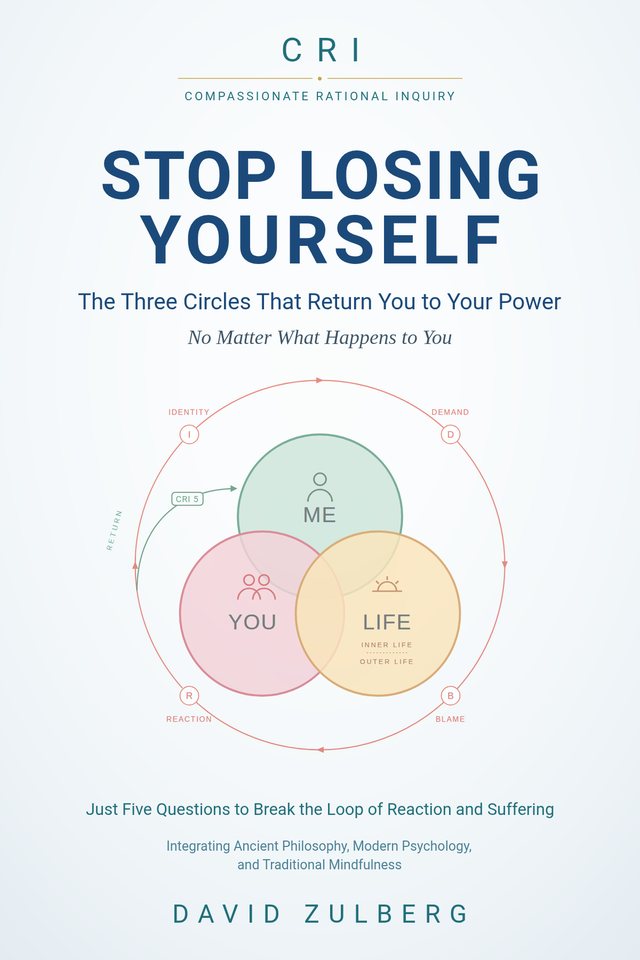
The Three Circles

A map so simple you can draw it on a napkin, and so precise you can find yourself on it mid-argument.

The loop

The four-step sequence your worst moments follow — every time, in order, faster than thought. Once you see it run, it can't hide.

CRI 5

The whole method, compressed into five moves you can walk in the middle of real life. In an elevator, if necessary.

The Two-Week Program

Fourteen mornings. Week one builds the architecture into your body. Week two takes it into your day. No day asks for more than a handful of minutes and one caught moment.

The ideas inside

Authentic sources

CRI is an original method, but it does not float free. It is built on some of the most tested ideas in psychology and some of the oldest in philosophy — and it is precise about which is which.

The shoulders it stands on

System 1 and System 2 thinking. Daniel Kahneman's fast and slow minds — and why the wisest advice reaches only one of them. The book shows you the conversation between the two that runs underneath every hard moment.
The Experiencing Self and the Remembering Self. Kahneman again: the story you tell about a moment is written by a different self than the one who lived it. The book shows you which one is running your decisions — and your memories.
The ABC model. Albert Ellis's discovery, carried into Cognitive Behavioral Therapy by Aaron Beck and confirmed by fifty years of research: events don't create your emotions. Beliefs do — and beliefs can be examined.
The Stoic insight. Epictetus and Marcus Aurelius, two thousand years earlier: we are disturbed not by things, but by our judgments about them. CRI takes this from quotable to usable.
The tyranny of the should. Karen Horney's phrase, Ellis's three musts, Beck's cognitive distortions — three traditions converging on the same finding: the word "should," aimed at yourself, at others, or at reality, is where suffering gets manufactured.
Maimonides. The twelfth-century physician-philosopher runs through this book like a spine: his image of insight as lightning over a dark road, his account of the rational mind as the very "image of God" in a human being, his warning that habit binds the mind, and his observation — eight centuries before neuroscience confirmed it — that character is built by many small repeated acts, not one great one.
The Observing Self. What the contemplative traditions — Krishnamurti, Ramana Maharshi, Alan Watts, and behind them Advaita Vedanta and Zen — pointed to for centuries: the awareness that can watch a thought without becoming it. The book gives it a working role, not a mystical one.
The hard problem of consciousness. David Chalmers' famous question — why is all this processing accompanied by a felt presence at all? The book takes the question seriously, and then asks a harder one: if awareness is all we are, what makes a human different from anything else that's aware?
Unconditional self-worth. Ellis's unconditional self-acceptance: worth that is not earned by performance or approval, because existence precedes evaluation. The book grounds it twice — once in psychology, once in philosophy.
The science of habit. Why insight alone doesn't change patterns — a finding Aristotle reached by observation, Menachem Mendel Levin mapped with startling precision in 1812, and neuroplasticity research now describes at the level of brain structure. The book is honest about what repetition builds, and about what it can never build.
Acceptance, values, and committed action. From Acceptance and Commitment Therapy: the place of each in an honest practice of change, and the order in which they work — plus Viktor Frankl's reminder that humans need meaning, not just relief.

What the book adds

The Three Circles — a map of what is yours to author and what never was. The IDBR loop — the four-step structure a hard moment follows, every time. Six wounded identities and their six resilient counterparts. The three root demands beneath a thousand daily ones. System 0 — the name CRI gives the awareness that precedes fast and slow thinking. And a method — CRI 5 and the Two-Week Program — that puts all of it to work.

If you work in psychology, coaching, or education: the framework is rigorous about its sources, careful about its claims, and designed to be taught. That is what the workshops are for.

The book is coming. The method already works.

Join the early-access list and be first to read it — or bring CRI to your team, or work with David directly.

Get early access Workshops & coaching